Preface: My RPG review series kinda fell by the wayside (like a lot of other things). This was largely a result of me quitting Dragon Quest III halfway through my first playthrough, and then helped along by the commencement of a separate project in which I've been introducing my significant other to the Final Fantasy series (I'm sparing her the tedium of the Dragon Quest series, because I want her to like the genre, not loathe it), to give her some context when she finally gets to play my own RPG (when it's ready for playtesting). So although I'm no longer playing through the Final Fantasies again myself (although I did play Final Fantasy IIIj for the first time recently), and thus not really writing reviews of them anymore, I consider it a worthwhile tradeoff to share my love of the genre with someone close to me (whom I get to watch playing these games for her first time). In a way, it's a bit like reliving my childhood. In any case, I did eventually go back and restart Dragon Quest III, which I finished, and then continued on to Dragon Quest IV, which I've now also completed. Here are some of my thoughts on those games - you may be relieved to hear that this will be [considerably] briefer than my previous, meandering "reviews".
Dragon Quest IV
(fyi, I'm doing these in reverse order)
This is the most fun I've had playing a Dragon Quest game so far (which bodes well for the next couple of releases). It's still frustrating at times (mainly being pummelled by enemies via a much too frequent random encounter rate) (oh, and using an expensive life spell five or seven times and not having it work...), but not nearly as consistently as in past games. I appreciate giving the Clinics access to the Imperial Scrolls of Honor, as the long trudge to the kings in their isolated halls of stone was becoming entirely gratuitous in DQIII.
I really enjoyed the way the game started with separate chapters, each introducing different characters (character development is still minimal, but leaps and bounds above previous games) that you get to grow a little bit before they all join your party in the last chapter. It was a great way to try out different jobs (merchant was the most fun, and a class that I never would have considered wasting time on before), without feeling like you're committing to something huge. Plus, I like how the extended team works in the latter part of the game much better than the character registration feature (which I never used) in DQIII.
I have mixed feelings about only being able to control the Hero and having the rest of the party on auto-pilot. I like being able to control my party on principle, but in practice, I haven't minded letting the computer take over so much. The AI is pretty decent (with a few exceptions - occasionally overusing useless spells and neglecting useful ones), and it makes the tedious quantity of battles just a little bit less labor-intensive. I've also learned that I can totally use more magic than I would normally ration out without it becoming a problem (in most cases, the OFFENSIVE tactic suited me for wiping out enemy groups more quickly).
It's worth mentioning, before I finish, that I used a couple of cheats - the Sword of Malice exploit in Taloon's chapter, and I used save states to shamelessly game the Casino (gambling sucks) - in order to get some better equipment/more gold (tip: four Meteorite Armbands means I can usually strike first and mitigate a lot of damage I would otherwise receive in battles). But given my experiences with Dragon Quest in the past, this is a game that I (rather uncharacteristically) have NO qualms about cheating at to even up the odds a little. And if it means I have more fun with less headaches, then where's the harm?
Dragon Quest III
Looking back at my notes, the highlights from Dragon Quest III were the introduction of the day/night cycle (which is pretty cool, even if it means you effectively have to explore each town twice), and my increasing confidence in using the Outside and Return spells (now with your choice of destination!), which are like Exit/Warp and fast travel (a Wing of Wyvern in spell form), which go a long way toward making dungeon crawling more manageable.
The combat was still frustrating as hell, though, and the option to switch jobs turned out to be more of a bane than a boon, as I got class change paralysis (not wanting to waste the time growing my experience through tedious battle after tedious battle for making the wrong strategic decision). It was so bad that I quit the game and started over many months later (as counterintuitive as that sounds).
And if I thought the Dragon Quest II endgame was annoying, having to basically replay Dragon Quest I after fighting the pseudo-final boss in DQIII (at which point I'd pretty much checked out) didn't have the novelty for me that I think the developers were going for. The irony is that just before this I had defended long RPG endgames in an online forum (thinking mostly of my fond memories of final dungeons in Final Fantasy - and having just recently played Final Fantasy III on the NES, which has a particularly long one*). But playing Dragon Quest totally flipped my opinion around - I guess it really depends on how much you like the game you're playing, whether you want it to drag on or not.
*Having later watched my SO trudge through the final dungeon in FFIII, only to get whupped by the final boss, and lose at least two hours of progress (it's hard enough finding that kind of time to sit down and play games together quietly at home, in the midst of our busy lives - especially post-COVID), I've gained a little more perspective. Ironically, I'd have to commend the endgame in Dragon Quest IV for being more forgiving - still long and drawn out (although not so bad as in the previous two titles), but more segmented and with ample opportunity for escape/saving your progress. I will certainly be taking this into account as I go into developing the endgame in my own RPG in the near future.
Anyway, it's a wonder I didn't quit the Dragon Quest series full stop after my experience with DQIII, but I can be persistent when I put my mind to something - and I'm glad I didn't quit, because with DQIV, the series finally appears to be turning itself around and beginning to embrace player-friendliness. I look forward to seeing what they came up with for the SNES, which was the golden age for the Final Fantasy series, at least.

Showing posts with label Dragon Quest. Show all posts
Showing posts with label Dragon Quest. Show all posts
Thursday, June 10, 2021

Saturday, September 23, 2017
World Map Analysis
It occurs to me that perhaps instead of just reconstructing these world maps, it might do to analyze them in some detail. If you haven't guessed yet, the first one is the world map from the original Final Fantasy, and the second one (hereafter referred to as "Alefgard") is the world map from the very first Dragon Quest/Warrior game. It's not entirely fair to compare these two games side by side, as Final Fantasy came after Dragon Quest, and represents a slight evolution over the earlier game (and is more comparable to Dragon Quest II), but that doesn't mean I can't discuss their differences.
Firstly, the FF world map is twice as large as Alefgard (256 pixels square vs. 128). But this is forgivable because in DQ, you have to walk everywhere, and you have to start from the same central location every single time (it's the only place you can save your game). Final Fantasy, on the other hand, features a ship for sea travel, and also an airship. As a result, Alefgard is a lot more "landlocked" than the world of Final Fantasy, where you can fly around and sail the high seas.
This distinction is relevant to my own RPG, because I've been debating whether to make my world map more landlocked (which is my first instinct, given how I envision the world in my head - and is more like the world we live in, I think - or at least the part of it I'm familiar with), or to mimic the style of the Final Fantasy games I am most heavily inspired by, with lots of wispy peninsulas and the like. I think that ultimately the decision will come down to what works best for my game, and I think that it will most likely turn out to be more landlocked than the FF map I've reproduced, but not quite so landlocked as Alefgard, since sea and air travel are still major elements of my game.
This may be headed slightly into off-topic territory, but another distinction my game has from the Final Fantasies I am inspired by is the fact that in those games, typically the world map represents the whole world (albeit sometimes with room in the game for other worlds, like underworlds and alternate dimensions and such). In my game, I want to give the player the sense that they may only be exploring part of the world they're in - just the part they have access to - since the plot is about rediscovering the world after the collapse of civilization. Also, I've reserved a whole separate "continent" (though maybe more of a large island) for the final stages of the game, and I want to keep it hidden and off limits until the player gets to a certain point. As such, though I may grant them versions of sea and air travel earlier, I have to contain their voyaging to a point so as to prevent them from entirely getting the sensation, as you do in Final Fantasy games, of sailing around the world and coming back to where you started. Yet, I still want to maintain that sense of heading out to sea, getting disoriented, and not knowing where you are. I had a great idea for a "deep sea" zone that's actually separate from the main world map, but the loss of the instantaneous map transfer ability in RPG Maker MV would make it clunky and dispel the illusion of sailing in a world that's much bigger than the actual map you're exploring.
Sigh, I don't have a solution to this problem as of yet, and it's something I'll have to figure out before the game is done. Ah well. I think that's enough analysis for now. I've already gone into depth about how much I love the game flow (which relates, in part, to how the world is set up) in the original Final Fantasy. Until next time!
Firstly, the FF world map is twice as large as Alefgard (256 pixels square vs. 128). But this is forgivable because in DQ, you have to walk everywhere, and you have to start from the same central location every single time (it's the only place you can save your game). Final Fantasy, on the other hand, features a ship for sea travel, and also an airship. As a result, Alefgard is a lot more "landlocked" than the world of Final Fantasy, where you can fly around and sail the high seas.
This distinction is relevant to my own RPG, because I've been debating whether to make my world map more landlocked (which is my first instinct, given how I envision the world in my head - and is more like the world we live in, I think - or at least the part of it I'm familiar with), or to mimic the style of the Final Fantasy games I am most heavily inspired by, with lots of wispy peninsulas and the like. I think that ultimately the decision will come down to what works best for my game, and I think that it will most likely turn out to be more landlocked than the FF map I've reproduced, but not quite so landlocked as Alefgard, since sea and air travel are still major elements of my game.
This may be headed slightly into off-topic territory, but another distinction my game has from the Final Fantasies I am inspired by is the fact that in those games, typically the world map represents the whole world (albeit sometimes with room in the game for other worlds, like underworlds and alternate dimensions and such). In my game, I want to give the player the sense that they may only be exploring part of the world they're in - just the part they have access to - since the plot is about rediscovering the world after the collapse of civilization. Also, I've reserved a whole separate "continent" (though maybe more of a large island) for the final stages of the game, and I want to keep it hidden and off limits until the player gets to a certain point. As such, though I may grant them versions of sea and air travel earlier, I have to contain their voyaging to a point so as to prevent them from entirely getting the sensation, as you do in Final Fantasy games, of sailing around the world and coming back to where you started. Yet, I still want to maintain that sense of heading out to sea, getting disoriented, and not knowing where you are. I had a great idea for a "deep sea" zone that's actually separate from the main world map, but the loss of the instantaneous map transfer ability in RPG Maker MV would make it clunky and dispel the illusion of sailing in a world that's much bigger than the actual map you're exploring.
Sigh, I don't have a solution to this problem as of yet, and it's something I'll have to figure out before the game is done. Ah well. I think that's enough analysis for now. I've already gone into depth about how much I love the game flow (which relates, in part, to how the world is set up) in the original Final Fantasy. Until next time!
Friday, September 22, 2017
World Mapping
I made a breakthrough the other day on some of the background and plot details for a significant dramatic turn in my RPG that occurs later in the game, past where I've done most of my work so far. I got some great dialogue written down for a confrontation that I'm really excited about. I wish I could finish working on this game already so I could show it to you. But it's a behemoth of a project. I'm finding that, as much as I can piece together some pretty neat maps, it's such a task and a chore, and more often than not it's the thing that's holding me back from making faster progress on my game. Simply put, I wish I could hire a mapper - somebody to take leads from me, but with a talent (and more of an enjoyment, rather than dread), for putting together game worlds of this sort. But, there's no point in wasting time complaining - I just gotta get it done, like it or not.
And on that subject, I've been thinking about world maps lately. I really want to put my world map together. I have a pretty strong idea of everything I want to be on there (even if I haven't mapped out the interiors of all the towns and dungeons yet), but it's such a colossal task, putting a whole world together, tile by tile. I can't decide whether it'd be better to work top-down as my instinct suggests (i.e., get a general idea of where everything sits and then fill in the details), or from the bottom up, piecing some tiles together here and there and seeing where they end up fitting together (not really my style). But one of the problems is that I'm not 100% sure where I want everything to go, especially in relation to everything else. I've sketched out the different areas - call them "countries" - on paper several times, and shuffled them around. But some of the game details, like how you get from A to B, and when you need to have access to C, will affect where things should be placed, and I guess I'm still not 100% confident about all of that.
Still, I've come to the realization that you can't expect yourself to be good at something the first time you've ever done it. And mapping is one thing, but creating world maps provides its own unique challenges. So I've decided that I should start out by practicing putting some world maps together, using some of the maps from the very games that serve as my primary inspiration (i.e., classic, 2D VG RPGs such as Final Fantasy and Dragon Quest/Warrior). At this point, it's just a copy job, so I'm not getting any practice using my creativity and imagination, but it's like starting out learning guitar by playing other people's songs. And copying huge 256 tile square maps is a daunting task (although I find it strangely relaxing - I could go in a trance and map like this for hours). But I think that digging in and getting my hands into the nitty gritty, examining these maps literally tile by tile, and seeing how the experts do it, will help me to build something of a muscle memory, and hone my instincts on what works well and what doesn't. So that when it comes time to design my own world map, it won't feel so much like I'm jumping out of a plane without a parachute.
So here's what I've completed so far, using RPG Maker MV's native tiles. Fans of the real old school RPGs will surely recognize them (hint, they're from games I've already reviewed right here on this blog). I haven't decided yet whether I'm going to do more or leave it at that (it takes a lot of time, but then I've drawn lots of inspiration from the SNES-era Final Fantasies, and they have some great world maps - especially FFV). It's tempting to just copy these games start to finish, because I love them so much, but while that would be good practice for putting an RPG together, it would be kind of pointless, as those games already exist... Ah well. here's this:
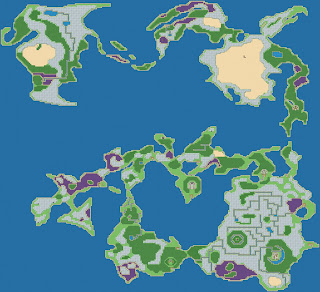

Can you name these worlds? :-3
And on that subject, I've been thinking about world maps lately. I really want to put my world map together. I have a pretty strong idea of everything I want to be on there (even if I haven't mapped out the interiors of all the towns and dungeons yet), but it's such a colossal task, putting a whole world together, tile by tile. I can't decide whether it'd be better to work top-down as my instinct suggests (i.e., get a general idea of where everything sits and then fill in the details), or from the bottom up, piecing some tiles together here and there and seeing where they end up fitting together (not really my style). But one of the problems is that I'm not 100% sure where I want everything to go, especially in relation to everything else. I've sketched out the different areas - call them "countries" - on paper several times, and shuffled them around. But some of the game details, like how you get from A to B, and when you need to have access to C, will affect where things should be placed, and I guess I'm still not 100% confident about all of that.
Still, I've come to the realization that you can't expect yourself to be good at something the first time you've ever done it. And mapping is one thing, but creating world maps provides its own unique challenges. So I've decided that I should start out by practicing putting some world maps together, using some of the maps from the very games that serve as my primary inspiration (i.e., classic, 2D VG RPGs such as Final Fantasy and Dragon Quest/Warrior). At this point, it's just a copy job, so I'm not getting any practice using my creativity and imagination, but it's like starting out learning guitar by playing other people's songs. And copying huge 256 tile square maps is a daunting task (although I find it strangely relaxing - I could go in a trance and map like this for hours). But I think that digging in and getting my hands into the nitty gritty, examining these maps literally tile by tile, and seeing how the experts do it, will help me to build something of a muscle memory, and hone my instincts on what works well and what doesn't. So that when it comes time to design my own world map, it won't feel so much like I'm jumping out of a plane without a parachute.
So here's what I've completed so far, using RPG Maker MV's native tiles. Fans of the real old school RPGs will surely recognize them (hint, they're from games I've already reviewed right here on this blog). I haven't decided yet whether I'm going to do more or leave it at that (it takes a lot of time, but then I've drawn lots of inspiration from the SNES-era Final Fantasies, and they have some great world maps - especially FFV). It's tempting to just copy these games start to finish, because I love them so much, but while that would be good practice for putting an RPG together, it would be kind of pointless, as those games already exist... Ah well. here's this:


Can you name these worlds? :-3
Friday, April 24, 2015
Review: Dragon Quest II (a.k.a. Dragon Warrior II)
Dragon Quest has its place in history, but I consider its sequel to be a superior game. It is certainly not without flaw (console RPGs were a fledgling genre in the NES era, still very much in the process of hammering out the details of their formula), but it offers many improvements over the first game.
To start with, the game opens with a dramatic "cut scene" (in which the action unfolds on screen without the player's control), involving a monster army invading a castle. Here we see the narrative potential of the RPG genre expanded in a monumental way. Although it is only a short, solitary scene in this game, this dramatic evolution paves the way for some of the best and most memorable scenes in RPGs later on down the line.
The graphics and gameplay do not seem to be significantly improved since the first Dragon Quest - at a glance - but a closer look will reveal some integral improvements to the gameplay formula. Starting with the fundamentals, you no longer have to select a command to climb stairs - you can just walk over them!
You are also given an option within the menu to equip the weapons and armor you carry, instead of just using the last one you bought (and automatically selling the one you had before that). This change is actually necessary on account of the fact that this game introduces multiple party members (the other two of which you meet along your journey). The game also features multiple enemies as well - up to as much as 8 on the screen at one time (depending on how big they are).
The battle command menu more closely resembles the one I'm familiar with from Final Fantasy. Also, the battles take up the whole screen, instead of just a central window. It's less pretty though, as you fight against a plain black background (even Final Fantasy had geographical backdrops along the top of the battle screen).
We're still dealing with a very basic plot here - evil sorcerer threatens the safety of the countryside and must be defeated. No interesting narrative complexities like, for example, the Big Bad is influencing events from the past through four generals who are draining the planet's energy. However, unlike Final Fantasy (for which each game in the series is self-contained), this game is a direct sequel to Dragon Quest, starring the descendants of the first game's hero, and taking place in a larger section of the same world (the first game's landmass is even accessible in the sequel, though it's been shrunken a bit - but not to the extent seen in Zelda II).
The first Dragon Quest was severely centralized to the starting castle, which was the only place you could save your game. I'm happy to discover that Dragon Quest II features multiple locations where you can save your game, but there's still not one in every town, and you can't save on the world map either. It's a decided improvement, but there's still room to grow.
The dungeons have improved immensely. The need for a light source (torch, magic spell, etc.) has been eliminated, for better or worse (it was a neat gameplay element, but also kind of a pain in the ass). The dungeons are still pretty basic, but much more immersive. Instead of the "dark cellar" look, they now come in two varieties: cave, and tower. The sea cave (which is actually volcanic) introduces some environmental specialization, which is an improvement over the last game, but it's still not to the level of Final Fantasy (whose Earth Cave felt different than its Ice Cave, which felt different than its Volcano, etc.).
Note the introduction of the ubiquitous poison status ailment, that slowly drains health! With multiple party members comes the need to occasionally revive fallen comrades (and the inn doesn't cover this service yet), so the curse remover from the first game has been upgraded, and now not only removes curses, but also poison, and brings fallen party members back from the dead (like the clinic from the first Final Fantasy). At a steep cost, though.
I am very pleased that the keys in this game (there are three of them, not including a certain one-time use special occasion key) are reusable master items and not disposable items that you have to keep wasting money on buying in mass quantities! There's also a spell you learn (at a rather high level) that ultimately makes the keys useless (which is good, because it frees up some inventory space).
On the subject of inventory, this game does not yet have a separate inventory for "key items". Also, your equipment takes up precious space in your item inventory. There are separate inventories for each of your three characters, though, which helps mitigate the need to carry more items for more people. The process by which you can trade items between characters is a bit tedious, though.
As a con, I'm sorry to say that Dragon Quest II has the same problem with encounter rates as the first game. You could walk two steps between encounters, or forty (and two seems to be far more frequent). Plus, with multiple enemies per encounter (and the overall high level of difficulty in this game), combat can become tedious and frustrating very quickly.
With multiple party members we get a glimpse into the compartmentalization of roles in RPGs. In the first Dragon Quest, your character took care of everything - namely, fighting and magic. Here, you have one character who specializes in fighting, another who specializes in magic, and a third who is kind of a jack of both trades. This would seem to be an early version of the class system which Final Fantasy would experiment with a whole lot.
Game progression is far more opaquely gated than last time, with multiple choke points requiring (for example) the acquisition of each of the two additions to your team, in order to advance to new areas. I have no problem with gating itself (though it's fun to try to "sequence break" games after you've mastered them), but I'll admit that having a slightly more logical obstacle (e.g., to use an example from Final Fantasy, having to find some TNT so the dwarves can blow open a canal for your ship to pass through) than a knight or an old man telling you "you can't go further until you do so-and-so" would be optimal.
Battle tactics are much different in a game that is not limited to one-on-one fights. As frustrating as it is to have your only character put to sleep, having an army of Magic Ants casting sleep on your entire party one after another is soul-crushingly annoying (I'm reminded of the paralysis-casting armies of Spectres/Geists/etc. in Final Fantasy). It also sucks that you have a tough fighter at the head of your party, but the enemies will frequently go after your weaker spellcaster. And if they take him out, you can no longer heal yourself. You can't even cast Return to start your trek over from the last village you visited. And it costs a lot of money to revive him. I know the game needs to be challenging, but this setup actually incentivizes me to hit reset rather than tough it out.
I think it's a bit sexist that in your whole group, the female is the only one who can't wear armor. (And it's not just because she's a spellcaster, because your other, male, spellcaster, who isn't much of a fighter anyway, can still wear armor). Maybe I'm just too progressive, though.
Mark this down in your history books, kids: Dragon Quest II features a ship vehicle! It's very slow, though. Your view isn't very wide, and the world is huge. Plus, like in Final Fantasy, you still encounter enemies on the open sea. So, lots of roaming, and again with the encounters becoming tedious.
The world opens up a lot once you get the ship, and it gets a lot less linear, too, as you're sent off looking for a bunch of crests with almost no clues as to where to find them (or what might be the best order in seeking them out). Frankly, I think I enjoyed the game better when it had a concise focus, and I knew what I was supposed to be doing. I love adventure games, but I think maybe the random encounters take away a lot of the fun of exploring and figuring things out on your own, by trial and error.
On the other hand, the larger world (with more places to visit) improves the pace of the game. Rarely have I felt trapped and in need of an excessive amount of grinding to level up before being strong enough to take on the next challenge (at least until Rhone, that is). So I guess it's a mixed blessing, at best.
I have to complain about the treasure chests. Apart from maybe one or two key items, chests mostly contain a paltry amount of gold, or outdated equipment that you don't need and can rarely be sold for a decent price. It seems that dungeons are designed more to trick you into walking down blind alleys than to force you to cover extra ground in order to collect potentially precious treasure.
The seemingly arbitrary scattering of save points and healers (who can bring fallen party members back to life) is inconvenient and annoying at times. Every town has an inn, which is good, but if a party member dies, then you're screwed until you can find a healer. And not every town that has a save point (which are, relatively speaking, rare) also has a healer, which means I'm wandering from one town to the next (and then the next), just trying to get my party member back to life so I can tackle a really difficult dungeon again... (An airship would be super useful here)! I'm not sure what benefit the scattering of healers is (the scattering of save points makes a little bit of sense). It makes the game harder, yeah, but in a frustrating rather than in a challenging way.
Not every town has an item shop, either, which is completely baffling. I can understand different towns having different wares, but you can only sell items (including weapons and armor) at item shops - weapon shops don't give you the option to sell. I have no idea what kind of sense that's supposed to make.
The inclusion of myriad teleporter pods throughout the world in this game would seem to alleviate some of the wandering troubles, but the connections are sometimes arbitrary, and often still require a good bit of walking around to get anywhere useful. Really, the ideal solution here is an airship. But alas, there is none in this game.
The farther I get in this game, the more complaints I'm going to have about the increasingly difficult and frustrating gameplay. For example: I hate the "strange jig" enemy technique. It's a good idea - attacking spellcasters where it hurts: their MP pool - but it's too strong. MP draining techniques have never been this frustrating in the Final Fantasy games I've played. Part of the problem is that the technique saps too much MP, but another part is that there are no items to recover MP - not even expensive ones! Well, there's one, but you can only win it in the lottery, which is a game of chance, and the odds are against you. Poor game design with this decision.
And it's especially frustrating considering that at a certain point in the game, I've come to rely on using a teleport spell to escape dungeons when I get weak, so I don't have to hold back and save my strength for the return journey. But one battle deep in a tough dungeon could have all of my spellcaster's MP sapped and then I'm screwed, having to restart and lose all my progress (read: experience) if I'm not willing to take the hit to my goldpurse. The threat of this happening is perfectly acceptable, but the game should provide an option to the player to avoid it (read: MP restoring items), even if that comes at a cost.
Let me just say that the Cave to Rhone is a real pain in the ass, with all of its unfair sorcery, and tough enemies.
I'm realizing that the enemy encounters are frustrating not because they're hard (although they are frequently challenging), but simply because they're a bore. They're way too frequent, but they also often take too much time to complete. In one floor of a dungeon, I often encounter enemies alone or in pairs, and it doesn't bother me so much. It's true that these encounters are easier, even where the individual enemies are no slouches (three against one or two is still good odds). But it's just that getting into an encounter with five enemies, whittling them down through several turns, then taking two steps and running into another encounter with six more enemies, is annoying.
Maybe the problem is that there is no "kill" spell like Nuke or Ultima or Meteo or what have you, that you can use (even if it requires great cost) to annihilate screens full of enemies (provided they're not super strong). That would go a long way in alleviating my frustration. But of the most powerful spells I've learned up to the second to last dungeon in the game, one of them only targets groups of like enemies (not every enemy on the screen), and the other one, though it does target every enemy on the screen, is not any stronger than the spellcaster's attack (he's a mediocre fighter (which says a lot about the spell), unlike my other spellcaster, but still not a good fighter), so the only advantage there is hitting all the enemies and not doing any more damage to each one, like a good upper level spell should. (Correction: you do learn a stronger spell at a certain point, but that doesn't really help at lower levels).
Interesting note: Attackbot seems like it might be a precursor to Final Fantasy's WarMech (superstrong robot enemy in high level dungeon), although it isn't quite on the same scale of woah.
It may be that I've lost my patience, or else that I'm trying to play through these games too quickly (I want to experience as much of them in as little time as possible, to boost my experience and fuel my inspiration while working on my own RPG). When I first played Final Fantasy (as a child), I considered the fact that playing it through to the end and beating it wasn't a task that took hours or days or weeks (as with most non-RPG games), but more on the scale of months, or even years, as part of what made it such a unique and awesome experience. It definitely seems that old games like Dragon Quest II would benefit from a slower pace, picking it up every now and then and playing for a bit until the difficulty and the grinding get frustrating, then putting it down and taking a rest, then picking it up again later and making some more progress, and slowly, gradually getting stronger and getting farther through the game. Trying to hurry through the process (as I am) leads to much frustration. That doesn't mean the game is broken, necessarily, but it certainly seems to be a different playing philosophy than what's popular nowadays.
On the other hand, some of the things you have to figure out to progress (like, in this game, the location of five hidden crests), are prohibitively difficult for someone without a strategy guide (and at this stage in my life, although I do have some pride in figuring things out for myself, I'm not above seeking aid to speed along the process and alleviate frustration). I'm a fan of games at least giving you some clue so that you can put the pieces together and figure everything out without relying on random, dumb, blind (mute?), luck. There are plenty of clues doled out by NPCs in these RPGs, but so frequently they are overly vague or otherwise inadequate. Whether this is a symptom of poor translation, as I think is often the case, or not, it's really not forgivable.
I like the whole idea of Rhone, as an endgame area (and not just a dungeon). It's hard to get to, and it has really tough enemies - big enemies that look intimidating, and pack a powerful punch. But the game is also merciful in that it gives you a free heal/save location right in the midst of it, which makes building up your levels until you're ready to face that final dungeon relatively easy. It's not only good from a gameplay standpoint, but it also has an effective mood and atmosphere for the player, which is a far cry from the last Dragon Quest, where even the last time you turned on the game before beating the final dungeon, you were still setting out from the same castle you started the game in. It gives that sense of geographical progress that the last game was missing, and that will be expanded upon in RPGs to come (for example, Final Fantasy IV's final dungeon is located on the moon).
Lack of pointers on what all the equipment does would be a lot more frustrating if I didn't have a strategy guide to consult. It would suck spending lots of gold on something that turns out to be not that good, or can't even be equipped by the character you bought it for. And I've heard rumors that the Magic Armor has special defensive properties against fire magic, which makes it more desirable than the hella-expensive (really, ridiculously overpriced - highest priced item in the game, and by far - even if it was worth a damn, which it may not be) Mink Coat, which has an only slightly higher defense rating. How are we supposed to figure these things out?
Rhone is accurately described as a death land. Not only are the enemies tough enough to wipe you out pretty quickly if you're not careful - and you need to grind for several levels after reaching Rhone before you even stand a chance inside the final dungeon - but they also have techniques like Defeat, which can instantly kill your party members, and, even worse, the Gold Batboon's "Sacrifice", which might as well be called Instant Game Over. So far as I've seen, it's 100% effective, and it wipes out your entire party, so if the Gold Batboon chooses to cast it, that's it, game over.
You do, thankfully, learn a Revive spell at higher levels, which helps, but it can only be used by the same character as the Return spell - which can rush you back to safety (where you can heal up and save) - which means that if he's dead, it's not like you can just bring him back to life and then zip outta there. If that one character dies, you're pretty much fucked. And when the monsters have the capability of completely wiping out your chances in a single battle (even when you have high HP and MP), well...let's just say it's hard. Nintendo hard.
The fact that your spells are frequently ineffective is really frustrating. I understand spells like Sleep and Defeat being occasionally (even frequently) ineffective - that's part of their gamble. But when regular damage spells like Firebane and Explodet aren't working against enemies - and not because they're immune to the spell - it kinda sucks. It's a waste of MP (and a waste of a turn, too).
Also, what sense does it make to give the Sacrifice spell to the same person that has both Revive and Return? I can understand that giving different people Sacrifice and Revive kind of reduces the high impact cost of Sacrifice (although you'd still have the added cost in terms of MP, having to bring your character back to life after using it), but Return too? I can see using Sacrifice when you get really desperate, just to survive a battle and then warp back home to save your skin and try again. Except, you can't warp because the person who knows that spell was your sacrifice! So there's really no point in using it, except like one time in the final final battle, if that...
We see here, in Dragon Quest II, what I presume to be the first example of the "boss gauntlet" in the final dungeon of an RPG. It's a great idea, and it really ups the stakes at the end of the game, although the sheer difficulty and reliance on luck rather than skill in order to persevere in this game makes it more frustrating than exciting.
The endgame here is just a real chore. Final dungeons in my favorite Final Fantasy games were also tough, and required multiple passes to clear, but I don't remember them being nearly as frustrating. Take the Crystal Tower in Final Fantasy IV, for example. The dungeon itself was interesting enough, with changing level design as you go deeper and deeper, that held your attention, and enough goodies (not just bosses serving as physical obstacles, but optional challenges that reward you with powerful equipment) to keep you motivated to explore and keep pushing on.
Here, though, after a while of grinding and pushing forward bit by bit, I'm just sick of it and want the game to be over and done with already. And I'm several levels stronger than I was to start with when I reached this area (and we're talking high levels here, like from Level 25 to Level 30), and I can still get pretty much wiped out in a single battle if my luck runs sour. (Plus, those encounters are still too frequent, on average). I don't want to have to rely so much on luck. I'd rather rely on my own power. But even at this high level, sometimes I'll cast an expensive offensive spell, and it won't even hit the enemy...
This game's replay value is essentially zilch, mainly because by the time you've beaten it (if you make it that far), you're so sick of it that you don't even want to play it anymore.
Giving bosses, in particular, the HealAll spell makes them especially challenging. I have yet to see an enemy exhaust its MP supply - but even that, if possible, is bound to require a lot of time. Otherwise, when the boss can just replenish all its HP with a single spell, it generally means the surest way of beating him is having a damage output (within a single turn in most instances, two or more only if you're lucky) that exceeds the boss's max HP, which is a high bar to pass. I think I prefer the approach that just gives bosses tons of HP to draw the battle out and make it more about endurance than the simple binary of whether or not you're a) lucky, and b) super-powered enough to obliterate the boss in a few turns. (Especially when leveling up further at this stage of the game involves zero novelty and extreme tedium). I haven't had any luck effectively casting StopSpell on bosses in this game either.
Functionally, it would seem that the final boss is simply a rehash of the first Dragon Quest's sorcerer transformed into a monstrous dragon (in a classic "this is the real final boss" move), but thematically, it introduces the concept of "Evil's Hand", in which what you think throughout the game will be the final boss is actually a puppet for the stronger, more monstrous evil that you will have to face in the end (Final Fantasy's Garland/Chaos and, better yet, Final Fantasy IV's Golbez/Zemus/Zeromus fit this pattern).
The final battle doesn't feel like a great challenge where you have to put all your strength and tactical knowledge together to defeat a powerful opponent. It feels like you just have to rail against him as much as you can, and hope that, by the power of luck, you happen to beat him (which depends largely on him not using HealAll too frequently). Your best spells don't even affect him. The only reliable damage you can deal is from your fighter. It got to the point where I was willing to break down and manipulate luck via the usage of save states (which is not something I like to do unless the game really makes it necessary), so I could just try fighting the final boss again and again, until I finally managed to beat him - not with any stronger stats, which would require way too much mind-numbing grinding, but with just a better roll of the dice - without making my way to him and beating all the prior bosses each and every time. It was frustrating enough doing it that way, I can't imagine how it would have been to original players without save state technology.
Concluding Remarks:
Dragon Quest II is really two different games. With all due respect to Dragon Quest - its place in history, and the foundation it laid down for a whole generation of video game RPGs - the first half of Dragon Quest II is a much more fun, and much less frustrating game. It feels like more of an adventure, with more exploration, and more characters, and not simply the distilled essence of tabletop RPG cliches. That having been said, it still comes up a little short of the first Final Fantasy in terms of epic scale, engrossing plot, and diversified gameplay mechanics.
Then you have the second half, where the difficulty gets ramped up, and the limitations and imbalance of the game escalate to a high level of frustration. It's worth giving Dragon Quest II a try, and, certainly, if you're looking for geek cred, you can put in the work to finish it. But don't feel bad if you have to drop it before the end, because I honestly can't imagine how the effort required to beat it could possibly be worth the paltry reward you get for seeing it through to the end. (Don't feel guilty about peeking in a strategy guide to see what the final boss looks like). There are better RPGs out there, with much better balance, that are much less frustrating to play, and to complete.
To start with, the game opens with a dramatic "cut scene" (in which the action unfolds on screen without the player's control), involving a monster army invading a castle. Here we see the narrative potential of the RPG genre expanded in a monumental way. Although it is only a short, solitary scene in this game, this dramatic evolution paves the way for some of the best and most memorable scenes in RPGs later on down the line.
The graphics and gameplay do not seem to be significantly improved since the first Dragon Quest - at a glance - but a closer look will reveal some integral improvements to the gameplay formula. Starting with the fundamentals, you no longer have to select a command to climb stairs - you can just walk over them!
You are also given an option within the menu to equip the weapons and armor you carry, instead of just using the last one you bought (and automatically selling the one you had before that). This change is actually necessary on account of the fact that this game introduces multiple party members (the other two of which you meet along your journey). The game also features multiple enemies as well - up to as much as 8 on the screen at one time (depending on how big they are).
The battle command menu more closely resembles the one I'm familiar with from Final Fantasy. Also, the battles take up the whole screen, instead of just a central window. It's less pretty though, as you fight against a plain black background (even Final Fantasy had geographical backdrops along the top of the battle screen).
We're still dealing with a very basic plot here - evil sorcerer threatens the safety of the countryside and must be defeated. No interesting narrative complexities like, for example, the Big Bad is influencing events from the past through four generals who are draining the planet's energy. However, unlike Final Fantasy (for which each game in the series is self-contained), this game is a direct sequel to Dragon Quest, starring the descendants of the first game's hero, and taking place in a larger section of the same world (the first game's landmass is even accessible in the sequel, though it's been shrunken a bit - but not to the extent seen in Zelda II).
The first Dragon Quest was severely centralized to the starting castle, which was the only place you could save your game. I'm happy to discover that Dragon Quest II features multiple locations where you can save your game, but there's still not one in every town, and you can't save on the world map either. It's a decided improvement, but there's still room to grow.
The dungeons have improved immensely. The need for a light source (torch, magic spell, etc.) has been eliminated, for better or worse (it was a neat gameplay element, but also kind of a pain in the ass). The dungeons are still pretty basic, but much more immersive. Instead of the "dark cellar" look, they now come in two varieties: cave, and tower. The sea cave (which is actually volcanic) introduces some environmental specialization, which is an improvement over the last game, but it's still not to the level of Final Fantasy (whose Earth Cave felt different than its Ice Cave, which felt different than its Volcano, etc.).
Note the introduction of the ubiquitous poison status ailment, that slowly drains health! With multiple party members comes the need to occasionally revive fallen comrades (and the inn doesn't cover this service yet), so the curse remover from the first game has been upgraded, and now not only removes curses, but also poison, and brings fallen party members back from the dead (like the clinic from the first Final Fantasy). At a steep cost, though.
I am very pleased that the keys in this game (there are three of them, not including a certain one-time use special occasion key) are reusable master items and not disposable items that you have to keep wasting money on buying in mass quantities! There's also a spell you learn (at a rather high level) that ultimately makes the keys useless (which is good, because it frees up some inventory space).
On the subject of inventory, this game does not yet have a separate inventory for "key items". Also, your equipment takes up precious space in your item inventory. There are separate inventories for each of your three characters, though, which helps mitigate the need to carry more items for more people. The process by which you can trade items between characters is a bit tedious, though.
As a con, I'm sorry to say that Dragon Quest II has the same problem with encounter rates as the first game. You could walk two steps between encounters, or forty (and two seems to be far more frequent). Plus, with multiple enemies per encounter (and the overall high level of difficulty in this game), combat can become tedious and frustrating very quickly.
With multiple party members we get a glimpse into the compartmentalization of roles in RPGs. In the first Dragon Quest, your character took care of everything - namely, fighting and magic. Here, you have one character who specializes in fighting, another who specializes in magic, and a third who is kind of a jack of both trades. This would seem to be an early version of the class system which Final Fantasy would experiment with a whole lot.
Game progression is far more opaquely gated than last time, with multiple choke points requiring (for example) the acquisition of each of the two additions to your team, in order to advance to new areas. I have no problem with gating itself (though it's fun to try to "sequence break" games after you've mastered them), but I'll admit that having a slightly more logical obstacle (e.g., to use an example from Final Fantasy, having to find some TNT so the dwarves can blow open a canal for your ship to pass through) than a knight or an old man telling you "you can't go further until you do so-and-so" would be optimal.
Battle tactics are much different in a game that is not limited to one-on-one fights. As frustrating as it is to have your only character put to sleep, having an army of Magic Ants casting sleep on your entire party one after another is soul-crushingly annoying (I'm reminded of the paralysis-casting armies of Spectres/Geists/etc. in Final Fantasy). It also sucks that you have a tough fighter at the head of your party, but the enemies will frequently go after your weaker spellcaster. And if they take him out, you can no longer heal yourself. You can't even cast Return to start your trek over from the last village you visited. And it costs a lot of money to revive him. I know the game needs to be challenging, but this setup actually incentivizes me to hit reset rather than tough it out.
I think it's a bit sexist that in your whole group, the female is the only one who can't wear armor. (And it's not just because she's a spellcaster, because your other, male, spellcaster, who isn't much of a fighter anyway, can still wear armor). Maybe I'm just too progressive, though.
Mark this down in your history books, kids: Dragon Quest II features a ship vehicle! It's very slow, though. Your view isn't very wide, and the world is huge. Plus, like in Final Fantasy, you still encounter enemies on the open sea. So, lots of roaming, and again with the encounters becoming tedious.
The world opens up a lot once you get the ship, and it gets a lot less linear, too, as you're sent off looking for a bunch of crests with almost no clues as to where to find them (or what might be the best order in seeking them out). Frankly, I think I enjoyed the game better when it had a concise focus, and I knew what I was supposed to be doing. I love adventure games, but I think maybe the random encounters take away a lot of the fun of exploring and figuring things out on your own, by trial and error.
On the other hand, the larger world (with more places to visit) improves the pace of the game. Rarely have I felt trapped and in need of an excessive amount of grinding to level up before being strong enough to take on the next challenge (at least until Rhone, that is). So I guess it's a mixed blessing, at best.
I have to complain about the treasure chests. Apart from maybe one or two key items, chests mostly contain a paltry amount of gold, or outdated equipment that you don't need and can rarely be sold for a decent price. It seems that dungeons are designed more to trick you into walking down blind alleys than to force you to cover extra ground in order to collect potentially precious treasure.
The seemingly arbitrary scattering of save points and healers (who can bring fallen party members back to life) is inconvenient and annoying at times. Every town has an inn, which is good, but if a party member dies, then you're screwed until you can find a healer. And not every town that has a save point (which are, relatively speaking, rare) also has a healer, which means I'm wandering from one town to the next (and then the next), just trying to get my party member back to life so I can tackle a really difficult dungeon again... (An airship would be super useful here)! I'm not sure what benefit the scattering of healers is (the scattering of save points makes a little bit of sense). It makes the game harder, yeah, but in a frustrating rather than in a challenging way.
Not every town has an item shop, either, which is completely baffling. I can understand different towns having different wares, but you can only sell items (including weapons and armor) at item shops - weapon shops don't give you the option to sell. I have no idea what kind of sense that's supposed to make.
The inclusion of myriad teleporter pods throughout the world in this game would seem to alleviate some of the wandering troubles, but the connections are sometimes arbitrary, and often still require a good bit of walking around to get anywhere useful. Really, the ideal solution here is an airship. But alas, there is none in this game.
The farther I get in this game, the more complaints I'm going to have about the increasingly difficult and frustrating gameplay. For example: I hate the "strange jig" enemy technique. It's a good idea - attacking spellcasters where it hurts: their MP pool - but it's too strong. MP draining techniques have never been this frustrating in the Final Fantasy games I've played. Part of the problem is that the technique saps too much MP, but another part is that there are no items to recover MP - not even expensive ones! Well, there's one, but you can only win it in the lottery, which is a game of chance, and the odds are against you. Poor game design with this decision.
And it's especially frustrating considering that at a certain point in the game, I've come to rely on using a teleport spell to escape dungeons when I get weak, so I don't have to hold back and save my strength for the return journey. But one battle deep in a tough dungeon could have all of my spellcaster's MP sapped and then I'm screwed, having to restart and lose all my progress (read: experience) if I'm not willing to take the hit to my goldpurse. The threat of this happening is perfectly acceptable, but the game should provide an option to the player to avoid it (read: MP restoring items), even if that comes at a cost.
Let me just say that the Cave to Rhone is a real pain in the ass, with all of its unfair sorcery, and tough enemies.
I'm realizing that the enemy encounters are frustrating not because they're hard (although they are frequently challenging), but simply because they're a bore. They're way too frequent, but they also often take too much time to complete. In one floor of a dungeon, I often encounter enemies alone or in pairs, and it doesn't bother me so much. It's true that these encounters are easier, even where the individual enemies are no slouches (three against one or two is still good odds). But it's just that getting into an encounter with five enemies, whittling them down through several turns, then taking two steps and running into another encounter with six more enemies, is annoying.
Maybe the problem is that there is no "kill" spell like Nuke or Ultima or Meteo or what have you, that you can use (even if it requires great cost) to annihilate screens full of enemies (provided they're not super strong). That would go a long way in alleviating my frustration. But of the most powerful spells I've learned up to the second to last dungeon in the game, one of them only targets groups of like enemies (not every enemy on the screen), and the other one, though it does target every enemy on the screen, is not any stronger than the spellcaster's attack (he's a mediocre fighter (which says a lot about the spell), unlike my other spellcaster, but still not a good fighter), so the only advantage there is hitting all the enemies and not doing any more damage to each one, like a good upper level spell should. (Correction: you do learn a stronger spell at a certain point, but that doesn't really help at lower levels).
Interesting note: Attackbot seems like it might be a precursor to Final Fantasy's WarMech (superstrong robot enemy in high level dungeon), although it isn't quite on the same scale of woah.
It may be that I've lost my patience, or else that I'm trying to play through these games too quickly (I want to experience as much of them in as little time as possible, to boost my experience and fuel my inspiration while working on my own RPG). When I first played Final Fantasy (as a child), I considered the fact that playing it through to the end and beating it wasn't a task that took hours or days or weeks (as with most non-RPG games), but more on the scale of months, or even years, as part of what made it such a unique and awesome experience. It definitely seems that old games like Dragon Quest II would benefit from a slower pace, picking it up every now and then and playing for a bit until the difficulty and the grinding get frustrating, then putting it down and taking a rest, then picking it up again later and making some more progress, and slowly, gradually getting stronger and getting farther through the game. Trying to hurry through the process (as I am) leads to much frustration. That doesn't mean the game is broken, necessarily, but it certainly seems to be a different playing philosophy than what's popular nowadays.
On the other hand, some of the things you have to figure out to progress (like, in this game, the location of five hidden crests), are prohibitively difficult for someone without a strategy guide (and at this stage in my life, although I do have some pride in figuring things out for myself, I'm not above seeking aid to speed along the process and alleviate frustration). I'm a fan of games at least giving you some clue so that you can put the pieces together and figure everything out without relying on random, dumb, blind (mute?), luck. There are plenty of clues doled out by NPCs in these RPGs, but so frequently they are overly vague or otherwise inadequate. Whether this is a symptom of poor translation, as I think is often the case, or not, it's really not forgivable.
I like the whole idea of Rhone, as an endgame area (and not just a dungeon). It's hard to get to, and it has really tough enemies - big enemies that look intimidating, and pack a powerful punch. But the game is also merciful in that it gives you a free heal/save location right in the midst of it, which makes building up your levels until you're ready to face that final dungeon relatively easy. It's not only good from a gameplay standpoint, but it also has an effective mood and atmosphere for the player, which is a far cry from the last Dragon Quest, where even the last time you turned on the game before beating the final dungeon, you were still setting out from the same castle you started the game in. It gives that sense of geographical progress that the last game was missing, and that will be expanded upon in RPGs to come (for example, Final Fantasy IV's final dungeon is located on the moon).
Lack of pointers on what all the equipment does would be a lot more frustrating if I didn't have a strategy guide to consult. It would suck spending lots of gold on something that turns out to be not that good, or can't even be equipped by the character you bought it for. And I've heard rumors that the Magic Armor has special defensive properties against fire magic, which makes it more desirable than the hella-expensive (really, ridiculously overpriced - highest priced item in the game, and by far - even if it was worth a damn, which it may not be) Mink Coat, which has an only slightly higher defense rating. How are we supposed to figure these things out?
Rhone is accurately described as a death land. Not only are the enemies tough enough to wipe you out pretty quickly if you're not careful - and you need to grind for several levels after reaching Rhone before you even stand a chance inside the final dungeon - but they also have techniques like Defeat, which can instantly kill your party members, and, even worse, the Gold Batboon's "Sacrifice", which might as well be called Instant Game Over. So far as I've seen, it's 100% effective, and it wipes out your entire party, so if the Gold Batboon chooses to cast it, that's it, game over.
You do, thankfully, learn a Revive spell at higher levels, which helps, but it can only be used by the same character as the Return spell - which can rush you back to safety (where you can heal up and save) - which means that if he's dead, it's not like you can just bring him back to life and then zip outta there. If that one character dies, you're pretty much fucked. And when the monsters have the capability of completely wiping out your chances in a single battle (even when you have high HP and MP), well...let's just say it's hard. Nintendo hard.
The fact that your spells are frequently ineffective is really frustrating. I understand spells like Sleep and Defeat being occasionally (even frequently) ineffective - that's part of their gamble. But when regular damage spells like Firebane and Explodet aren't working against enemies - and not because they're immune to the spell - it kinda sucks. It's a waste of MP (and a waste of a turn, too).
Also, what sense does it make to give the Sacrifice spell to the same person that has both Revive and Return? I can understand that giving different people Sacrifice and Revive kind of reduces the high impact cost of Sacrifice (although you'd still have the added cost in terms of MP, having to bring your character back to life after using it), but Return too? I can see using Sacrifice when you get really desperate, just to survive a battle and then warp back home to save your skin and try again. Except, you can't warp because the person who knows that spell was your sacrifice! So there's really no point in using it, except like one time in the final final battle, if that...
We see here, in Dragon Quest II, what I presume to be the first example of the "boss gauntlet" in the final dungeon of an RPG. It's a great idea, and it really ups the stakes at the end of the game, although the sheer difficulty and reliance on luck rather than skill in order to persevere in this game makes it more frustrating than exciting.
The endgame here is just a real chore. Final dungeons in my favorite Final Fantasy games were also tough, and required multiple passes to clear, but I don't remember them being nearly as frustrating. Take the Crystal Tower in Final Fantasy IV, for example. The dungeon itself was interesting enough, with changing level design as you go deeper and deeper, that held your attention, and enough goodies (not just bosses serving as physical obstacles, but optional challenges that reward you with powerful equipment) to keep you motivated to explore and keep pushing on.
Here, though, after a while of grinding and pushing forward bit by bit, I'm just sick of it and want the game to be over and done with already. And I'm several levels stronger than I was to start with when I reached this area (and we're talking high levels here, like from Level 25 to Level 30), and I can still get pretty much wiped out in a single battle if my luck runs sour. (Plus, those encounters are still too frequent, on average). I don't want to have to rely so much on luck. I'd rather rely on my own power. But even at this high level, sometimes I'll cast an expensive offensive spell, and it won't even hit the enemy...
This game's replay value is essentially zilch, mainly because by the time you've beaten it (if you make it that far), you're so sick of it that you don't even want to play it anymore.
Giving bosses, in particular, the HealAll spell makes them especially challenging. I have yet to see an enemy exhaust its MP supply - but even that, if possible, is bound to require a lot of time. Otherwise, when the boss can just replenish all its HP with a single spell, it generally means the surest way of beating him is having a damage output (within a single turn in most instances, two or more only if you're lucky) that exceeds the boss's max HP, which is a high bar to pass. I think I prefer the approach that just gives bosses tons of HP to draw the battle out and make it more about endurance than the simple binary of whether or not you're a) lucky, and b) super-powered enough to obliterate the boss in a few turns. (Especially when leveling up further at this stage of the game involves zero novelty and extreme tedium). I haven't had any luck effectively casting StopSpell on bosses in this game either.
Functionally, it would seem that the final boss is simply a rehash of the first Dragon Quest's sorcerer transformed into a monstrous dragon (in a classic "this is the real final boss" move), but thematically, it introduces the concept of "Evil's Hand", in which what you think throughout the game will be the final boss is actually a puppet for the stronger, more monstrous evil that you will have to face in the end (Final Fantasy's Garland/Chaos and, better yet, Final Fantasy IV's Golbez/Zemus/Zeromus fit this pattern).
The final battle doesn't feel like a great challenge where you have to put all your strength and tactical knowledge together to defeat a powerful opponent. It feels like you just have to rail against him as much as you can, and hope that, by the power of luck, you happen to beat him (which depends largely on him not using HealAll too frequently). Your best spells don't even affect him. The only reliable damage you can deal is from your fighter. It got to the point where I was willing to break down and manipulate luck via the usage of save states (which is not something I like to do unless the game really makes it necessary), so I could just try fighting the final boss again and again, until I finally managed to beat him - not with any stronger stats, which would require way too much mind-numbing grinding, but with just a better roll of the dice - without making my way to him and beating all the prior bosses each and every time. It was frustrating enough doing it that way, I can't imagine how it would have been to original players without save state technology.
Concluding Remarks:
Dragon Quest II is really two different games. With all due respect to Dragon Quest - its place in history, and the foundation it laid down for a whole generation of video game RPGs - the first half of Dragon Quest II is a much more fun, and much less frustrating game. It feels like more of an adventure, with more exploration, and more characters, and not simply the distilled essence of tabletop RPG cliches. That having been said, it still comes up a little short of the first Final Fantasy in terms of epic scale, engrossing plot, and diversified gameplay mechanics.
Then you have the second half, where the difficulty gets ramped up, and the limitations and imbalance of the game escalate to a high level of frustration. It's worth giving Dragon Quest II a try, and, certainly, if you're looking for geek cred, you can put in the work to finish it. But don't feel bad if you have to drop it before the end, because I honestly can't imagine how the effort required to beat it could possibly be worth the paltry reward you get for seeing it through to the end. (Don't feel guilty about peeking in a strategy guide to see what the final boss looks like). There are better RPGs out there, with much better balance, that are much less frustrating to play, and to complete.
Monday, November 24, 2014
Review: Dragon Quest (a.k.a. Dragon Warrior)
(For my fellow players, here is a link to the most helpful guide I found on this game).
I thought it might be helpful to go back and play some classic RPGs for inspiration. And in light of my recent decision to scale back the complexity of my game (at least from the start), the first Dragon Quest (known in North America as Dragon Warrior) seemed like the perfect place to start. It actually preceded the first Final Fantasy by about a year or so, and is at least an order of magnitude simpler.
I find the simplicity very appealing as a novice (and solo) developer, and I'm tempted to try building a bare bones proto-RPG as a practice exercise - to sort of teach myself the basics before I try putting together something more complicated, with multiple playable characters and such. Except, I'm not sure how confident I feel about diverting that time and effort from the game I really want to be working on (Dragonfaith).
But about Dragon Quest. I never actually played any of the Dragon Quest games until my friend gave me his NES cartridge not that many years ago, despite growing up on the Final Fantasy series (which seems to have attracted more popularity in America). But I've just finished playing through it for the second time ever, and I jotted down some of my (more or less scattered) thoughts while I was playing it:
* I knew the gameplay was going to be basic for a game this old, but wow - you have to select commands from a menu to do simple things like talk to people and use stairs!
* Combat utilizes a front-facing battle screen, where the monsters are drawn to face the player as he sits in front of the screen, and the hero is not drawn on the screen at all. This is interesting, because this is the default battle system in RPG Maker VX Ace, and it's not the one I'm used to - which is the side-facing battle screen of Final Fantasy.
* Very basic combat. Party includes only a single hero (as opposed to the first Final Fantasy's four-hero party), and you only fight a single monster at a time. This means that all the physical and magic skills are combined into one character. I like that, from a simplistic development perspective.
* I like the spells in this game. They're very basic, but functional, and there's a good mix of spells designed for combat (Heal, Hurt, Sleep, Stopspell), and spells that are useful outside of combat (Radiant, Outside, Return, Repel). No spell feels useless. Well, except Hurtmore, since by the time I learned it, I didn't really need it for anything except the final boss, and every time I tried to use it on the final boss, it failed, so I just gave up trying. But it's not like Final Fantasy where you have a ton of spells that do the same thing (Fire, Ice, Lit - although I do like the concept of elements), and a million different status ailments or enhancements, many of which work so rarely that you never bother using them.
* Stats begin in the single digits. I think this really makes a lot of sense. The default stats on RPG Maker VX Ace are totally out of whack, and have level 1 actors dealing hundreds of damage right from out of the gate. I don't like that. In Dragon Quest, you start with single digit stats. The first enemies are slimes that do 1 or 2 damage, and only have a few HP. You're evenly matched at first, until you begin to level up and then eventually the slimes are dust you brush off your shoulder. That's the way it should be. Your growth is gradual and starts from a reasonable point. By the end of the game, you're probably not more than level 20, and dealing a hundred damage at once is unthinkable (as opposed to Final Fantasy's 9999 damage cap at level 99). Again, we're dealing with a simpler system here.
* Here's something that I find very interesting. Unlike Final Fantasy, which uses a gated system (which I am admittedly fond of) whereby parts of the game world are opened up to the player gradually as they unlock certain obstacles (chronicled here), when you start Dragon Quest, the whole world (apart from the final dungeon alone) is theoretically open to you, and the only thing keeping you from going anywhere you want is that the monsters get stronger and you need to build up your stats first, if you don't want your ass handed to you on a platter. I actually think this is very clever.
* On the other hand, the downside of this is that the gameplay in Dragon Quest relies heavily on "grinding" - where you're fighting the same monsters over and over again just to level up - which isn't very fun. Later, more advanced RPGs have enough story content to keep you moving through the game, whereas here it feels like you're frequently getting stuck and you can't advance in the game without a whole lot of fighting the same monsters over and over again. It gives you more time to grow with the game, but it does it in a way that feels cheap, like filler.
* Dragon Quest features a very basic fantasy setting with conventional elements (e.g., a knight trying to save a princess from a dragon). While this is a very simplified approach and eliminates any concern for developing complicated story elements, it also greatly reduces the player's incentive to finish the game and find out what happens next, as they are probably not that invested in the characters or the plot (unlike the more advanced RPGs I know of).
* The dungeons are dark, and require a torch (or other light source) to be properly explored. This wasn't the case in Final Fantasy games, but I think it's a neat gameplay element. Although, the dungeons themselves are all very samey, and suffer from a lack of graphical variation (which is something that Final Fantasy, at least, succeeded on).
* There is, mostly, a logical progression in the weapons/armor you use. While I am fond of the Final Fantasy system of having tons of equipment with an at times arbitrary hierarchy of attack/defense power, I am also attracted to a simpler, more intuitive system where, instead of getting a new sword and set of armor in every town, you progress naturally through stronger weapons and armor (like from a bamboo pole to a club to a copper sword to a hand axe to a broad sword, or from clothes to leather armor to chain mail to a half plate to a full plate). This suits my RPG better in a conceptual sense, in that part of its genesis was inspired by a desire to introduce some level of realism to typical RPG cliches (explained here), but I have yet to come to a final decision about how I'm going to handle equipment in my own game.
* Considering the difficulty of getting magic keys - their high price and the difficulty in originally getting to the town that sells them - the reward is rarely worthwhile. Though there are some parts of the game that require having the keys to advance, a lot of the treasure chests and areas unlocked by them are bogus. It doesn't have the same feeling of accomplishment as getting the Mystic Key in Final Fantasy, for example.
* The only place you can save your game is at the king in the first castle. This is an interesting choice, conceptually, since it has to do with recording your deeds on the "Imperial Scroll of Honor", but I don't think I like it, from a more practical perspective. Gameplay is inevitably centralized around the first castle (instead of moving from town to town as you progress through the game), such that the last time you load up your game, to brave the final dungeon and battle the final boss, you start playing from the same spot you did when you first started the game (and even though the final dungeon is tantalizingly in view of the first castle, it requires a roundabout trek to access it).
* This means that there's a lot of tedious coming and going, particularly in later parts of the game (and with no vehicles to speed things up). The world map is not super humongous, but you have to consider all the time spent traveling through early areas later in the game. Already, at level 10, fighting slimes is nothing but an annoying waste of time. They can in no way threaten your safety, and the paltry reward you get for killing them isn't even worth the effort of squashing them under your boot. And yet, you can't ignore them, because they keep throwing themselves at you like pests!
* You do learn a handy spell (Repel) to solve this problem, but considering that it only works on weaker enemies, and is therefore only a convenience, and not a significant battle advantage, you learn it much too late in the game (level 15).
* Maybe this is just me (I tend to play games in the same risk-averse fashion that I live my life), but the difference between tiers of enemies often seems to be life and death. If I'm on the verge between one tier and the next, I find that there's a tedious period during which I'm strong enough to beat the lower tier without breaking a sweat, but still weak enough to be wiped out by the larger tier in a single battle. Which means, rather than risking my life to fight the stronger enemies which would earn me more experience so I can level up faster, I'm stuck mindlessly fighting the weaker enemies at a slower rate of progress.
* On the other hand, death in this game only means that you lose half your gold and have to start back at the castle. Losing all that hard-won gold is unacceptable earlier in the game, but it seems that there comes a point later on when you max out your buyable equipment, and gold becomes pretty much useless to you.
* I don't know if there's even any point in worrying about this being a spoiler, but all I'll say is that the choice the Dragonlord gives you at the end of the game (and the penalty for choosing unwisely) is ingenious.
Concluding Remarks: I understand that Dragon Quest was an extremely influential pioneer in the realm of console RPGs, paving the way for the likes of the immensely popular Final Fantasy series (among other games), and nothing can take that away from it. Taken on its own merit, it's still a fun and creative little game, allowing for its unavoidably primitive nature (and in some ways, the simplicity can be appealing).
However, I consider the alleged tweaks that have been made to better balance the combat in recent "remixed" versions to be fixing the game (as opposed to tinkering with it), as in its original state, the grinding can become frustrating to the point that only a diehard old school RPG fan would have the patience to play it through to the ending. I feel like I spent about a month longer on this game than I should have - given its simple story - and much of that time was spent dragging my feet because I was too bored to sit and grind for another hour.
Meanwhile, pioneer though it was, Dragon Quest is overshadowed by the more evolved RPGs that followed in its wake, both in the Final Fantasy series, and, presumably (as I have yet to play them, though I'm planning to make some time for it in the near future) in its own series. More precisely, it is my opinion that the golden age of the console RPG was the Super Nintendo years. But it's still illuminating to jump back and see where the boom began.
I thought it might be helpful to go back and play some classic RPGs for inspiration. And in light of my recent decision to scale back the complexity of my game (at least from the start), the first Dragon Quest (known in North America as Dragon Warrior) seemed like the perfect place to start. It actually preceded the first Final Fantasy by about a year or so, and is at least an order of magnitude simpler.
I find the simplicity very appealing as a novice (and solo) developer, and I'm tempted to try building a bare bones proto-RPG as a practice exercise - to sort of teach myself the basics before I try putting together something more complicated, with multiple playable characters and such. Except, I'm not sure how confident I feel about diverting that time and effort from the game I really want to be working on (Dragonfaith).
But about Dragon Quest. I never actually played any of the Dragon Quest games until my friend gave me his NES cartridge not that many years ago, despite growing up on the Final Fantasy series (which seems to have attracted more popularity in America). But I've just finished playing through it for the second time ever, and I jotted down some of my (more or less scattered) thoughts while I was playing it:
* I knew the gameplay was going to be basic for a game this old, but wow - you have to select commands from a menu to do simple things like talk to people and use stairs!
* Combat utilizes a front-facing battle screen, where the monsters are drawn to face the player as he sits in front of the screen, and the hero is not drawn on the screen at all. This is interesting, because this is the default battle system in RPG Maker VX Ace, and it's not the one I'm used to - which is the side-facing battle screen of Final Fantasy.
* Very basic combat. Party includes only a single hero (as opposed to the first Final Fantasy's four-hero party), and you only fight a single monster at a time. This means that all the physical and magic skills are combined into one character. I like that, from a simplistic development perspective.
* I like the spells in this game. They're very basic, but functional, and there's a good mix of spells designed for combat (Heal, Hurt, Sleep, Stopspell), and spells that are useful outside of combat (Radiant, Outside, Return, Repel). No spell feels useless. Well, except Hurtmore, since by the time I learned it, I didn't really need it for anything except the final boss, and every time I tried to use it on the final boss, it failed, so I just gave up trying. But it's not like Final Fantasy where you have a ton of spells that do the same thing (Fire, Ice, Lit - although I do like the concept of elements), and a million different status ailments or enhancements, many of which work so rarely that you never bother using them.
* Stats begin in the single digits. I think this really makes a lot of sense. The default stats on RPG Maker VX Ace are totally out of whack, and have level 1 actors dealing hundreds of damage right from out of the gate. I don't like that. In Dragon Quest, you start with single digit stats. The first enemies are slimes that do 1 or 2 damage, and only have a few HP. You're evenly matched at first, until you begin to level up and then eventually the slimes are dust you brush off your shoulder. That's the way it should be. Your growth is gradual and starts from a reasonable point. By the end of the game, you're probably not more than level 20, and dealing a hundred damage at once is unthinkable (as opposed to Final Fantasy's 9999 damage cap at level 99). Again, we're dealing with a simpler system here.
* Here's something that I find very interesting. Unlike Final Fantasy, which uses a gated system (which I am admittedly fond of) whereby parts of the game world are opened up to the player gradually as they unlock certain obstacles (chronicled here), when you start Dragon Quest, the whole world (apart from the final dungeon alone) is theoretically open to you, and the only thing keeping you from going anywhere you want is that the monsters get stronger and you need to build up your stats first, if you don't want your ass handed to you on a platter. I actually think this is very clever.
* On the other hand, the downside of this is that the gameplay in Dragon Quest relies heavily on "grinding" - where you're fighting the same monsters over and over again just to level up - which isn't very fun. Later, more advanced RPGs have enough story content to keep you moving through the game, whereas here it feels like you're frequently getting stuck and you can't advance in the game without a whole lot of fighting the same monsters over and over again. It gives you more time to grow with the game, but it does it in a way that feels cheap, like filler.
* Dragon Quest features a very basic fantasy setting with conventional elements (e.g., a knight trying to save a princess from a dragon). While this is a very simplified approach and eliminates any concern for developing complicated story elements, it also greatly reduces the player's incentive to finish the game and find out what happens next, as they are probably not that invested in the characters or the plot (unlike the more advanced RPGs I know of).
* The dungeons are dark, and require a torch (or other light source) to be properly explored. This wasn't the case in Final Fantasy games, but I think it's a neat gameplay element. Although, the dungeons themselves are all very samey, and suffer from a lack of graphical variation (which is something that Final Fantasy, at least, succeeded on).
* There is, mostly, a logical progression in the weapons/armor you use. While I am fond of the Final Fantasy system of having tons of equipment with an at times arbitrary hierarchy of attack/defense power, I am also attracted to a simpler, more intuitive system where, instead of getting a new sword and set of armor in every town, you progress naturally through stronger weapons and armor (like from a bamboo pole to a club to a copper sword to a hand axe to a broad sword, or from clothes to leather armor to chain mail to a half plate to a full plate). This suits my RPG better in a conceptual sense, in that part of its genesis was inspired by a desire to introduce some level of realism to typical RPG cliches (explained here), but I have yet to come to a final decision about how I'm going to handle equipment in my own game.
* Considering the difficulty of getting magic keys - their high price and the difficulty in originally getting to the town that sells them - the reward is rarely worthwhile. Though there are some parts of the game that require having the keys to advance, a lot of the treasure chests and areas unlocked by them are bogus. It doesn't have the same feeling of accomplishment as getting the Mystic Key in Final Fantasy, for example.
* The only place you can save your game is at the king in the first castle. This is an interesting choice, conceptually, since it has to do with recording your deeds on the "Imperial Scroll of Honor", but I don't think I like it, from a more practical perspective. Gameplay is inevitably centralized around the first castle (instead of moving from town to town as you progress through the game), such that the last time you load up your game, to brave the final dungeon and battle the final boss, you start playing from the same spot you did when you first started the game (and even though the final dungeon is tantalizingly in view of the first castle, it requires a roundabout trek to access it).
* This means that there's a lot of tedious coming and going, particularly in later parts of the game (and with no vehicles to speed things up). The world map is not super humongous, but you have to consider all the time spent traveling through early areas later in the game. Already, at level 10, fighting slimes is nothing but an annoying waste of time. They can in no way threaten your safety, and the paltry reward you get for killing them isn't even worth the effort of squashing them under your boot. And yet, you can't ignore them, because they keep throwing themselves at you like pests!
* You do learn a handy spell (Repel) to solve this problem, but considering that it only works on weaker enemies, and is therefore only a convenience, and not a significant battle advantage, you learn it much too late in the game (level 15).
* Maybe this is just me (I tend to play games in the same risk-averse fashion that I live my life), but the difference between tiers of enemies often seems to be life and death. If I'm on the verge between one tier and the next, I find that there's a tedious period during which I'm strong enough to beat the lower tier without breaking a sweat, but still weak enough to be wiped out by the larger tier in a single battle. Which means, rather than risking my life to fight the stronger enemies which would earn me more experience so I can level up faster, I'm stuck mindlessly fighting the weaker enemies at a slower rate of progress.
* On the other hand, death in this game only means that you lose half your gold and have to start back at the castle. Losing all that hard-won gold is unacceptable earlier in the game, but it seems that there comes a point later on when you max out your buyable equipment, and gold becomes pretty much useless to you.
* I don't know if there's even any point in worrying about this being a spoiler, but all I'll say is that the choice the Dragonlord gives you at the end of the game (and the penalty for choosing unwisely) is ingenious.
Concluding Remarks: I understand that Dragon Quest was an extremely influential pioneer in the realm of console RPGs, paving the way for the likes of the immensely popular Final Fantasy series (among other games), and nothing can take that away from it. Taken on its own merit, it's still a fun and creative little game, allowing for its unavoidably primitive nature (and in some ways, the simplicity can be appealing).
However, I consider the alleged tweaks that have been made to better balance the combat in recent "remixed" versions to be fixing the game (as opposed to tinkering with it), as in its original state, the grinding can become frustrating to the point that only a diehard old school RPG fan would have the patience to play it through to the ending. I feel like I spent about a month longer on this game than I should have - given its simple story - and much of that time was spent dragging my feet because I was too bored to sit and grind for another hour.
Meanwhile, pioneer though it was, Dragon Quest is overshadowed by the more evolved RPGs that followed in its wake, both in the Final Fantasy series, and, presumably (as I have yet to play them, though I'm planning to make some time for it in the near future) in its own series. More precisely, it is my opinion that the golden age of the console RPG was the Super Nintendo years. But it's still illuminating to jump back and see where the boom began.
Subscribe to:
Posts (Atom)